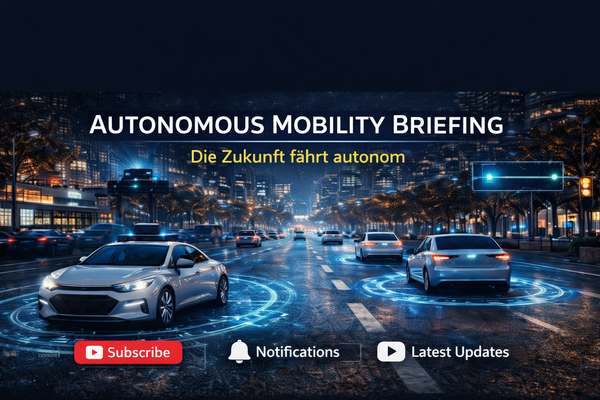
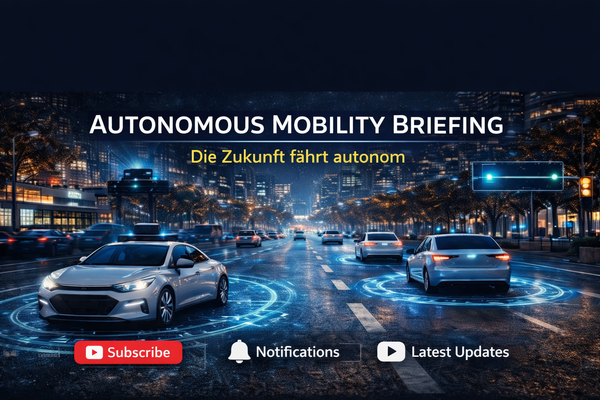
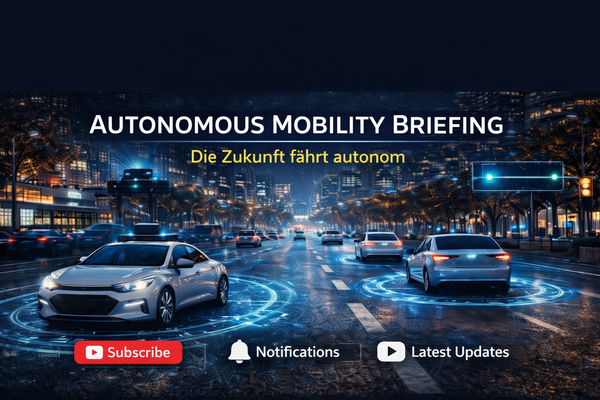
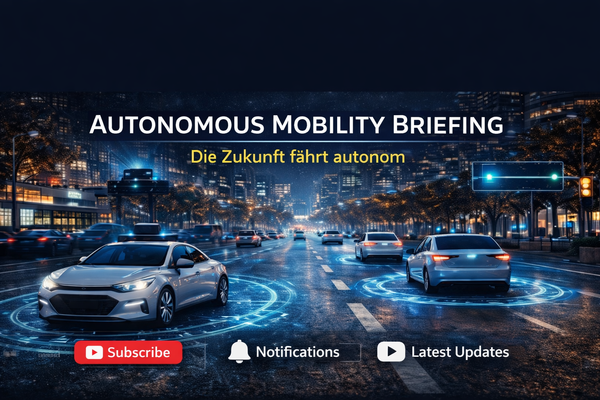
Autonomous Mobility Briefing #12
Uber moves toward Munich, WeRide and Uber target Madrid, Tesla FSD Supervised advances in Europe, and Waymo brings Ojai to riders. Europe is becoming a robotaxi test field.
ENGLISH VERSION
Robotaxi Xpress KW23: Europe is becoming a robotaxi test field.
For normal users, the question is simple: when will robotaxis become something you can actually use in Europe?
This week shows why the answer is getting more concrete. Uber is moving toward Munich. WeRide and Uber are targeting Madrid. Tesla FSD Supervised is moving forward in Europe. And Waymo is bringing a new passenger-focused robotaxi vehicle to riders.
LATEST FROM THE CHANNEL
This week’s video from Autonomous Mobility Briefing:
Robotaxi Xpress KW23: Uber, Tesla & Waymo im Check
Der Führerschein STIRBT: Brauchst du ihn bald nicht mehr?
Führerschein bald nutzlos? Fahrer oder Fahrgast?
GERMANY
Uber is planning a robotaxi pilot program in Munich with Autobrains and NVIDIA.
Uber, Autobrains and NVIDIA announced a Munich robotaxi program based on NVIDIA DRIVE Hyperion. The service is still subject to regulatory approval. What is not clearly stated yet: whether the first rides will already be driverless or initially supervised.
That matters. For passengers, a robotaxi looks simple: open the app, the vehicle arrives, the ride starts. For the operator, the difficult part begins behind the scenes: approval, fleet operation, remote support, vehicle availability, incidents and daily service quality.
Source: Uber / Autobrains / NVIDIA
https://investor.uber.com/news-events/news/press-release-details/2026/Autobrains-and-Uber-to-Launch-Agentic-AI-Robotaxi-Program-in-Munich-built-on-NVIDIA-DRIVE-Hyperion-2026-yMEt3xDSDA/default.aspx
EUROPE
WeRide, Uber and AVOMO are bringing a robotaxi pilot to Madrid.
Madrid is expected to become WeRide and Uber’s first joint European market entry, with public operations planned later this year via the Uber app. The project is being developed with AVOMO and in partnership with the Madrid regional government.
The pattern is important: Uber is not relying on one single autonomous-driving partner in Europe. Munich is connected to Autobrains. Madrid is connected to WeRide and AVOMO. This looks less like one big launch and more like a network of local operating partnerships.
Source: Uber / WeRide / AVOMO
https://investor.uber.com/news-events/news/press-release-details/2026/WeRide-Uber-and-AVOMO-Bring-Robotaxis-to-Madrid/default.aspx
TESLA
Tesla FSD Supervised is moving further into Europe.
After the Netherlands and Lithuania, Estonia has also cleared Tesla FSD Supervised for road use, following recognition of the Dutch type certification.
For Tesla, this is a visible step forward. Europe has long been the difficult market: many countries, many authorities, many legal frameworks. Now Tesla is getting its system closer to European roads country by country.
FSD Supervised remains a supervised system. But the direction is clear: Tesla is making regulatory progress in Europe.
Source: Reuters
https://www.reuters.com/business/estonia-clears-tesla-fsd-roads-company-says-rollout-begin-soon-2026-05-29/
GLOBAL
Waymo is bringing Ojai to its first riders.
Waymo has started first rider trips with Ojai, its new robotaxi vehicle based on the Zeekr RT platform and equipped with the sixth-generation Waymo Driver.
This is not only about a new vehicle. It is about passenger design. More space, easier entry, luggage, comfort and accessibility matter when robotaxis move from demo logic into daily service.
A robotaxi is not just sensors and software. Somebody sits inside. Maybe with bags. Maybe with a child. Maybe with limited mobility. That is where the vehicle design becomes part of the operating model.
Source: Waymo
https://waymo.com/blog/2026/05/welcoming-riders-in-the-ojai
BOTTOM LINE
Europe is becoming a robotaxi test field.
The regulatory hurdle is getting smaller. The operational complexity is getting bigger.
That is the real signal this week.
Robotaxis in Europe will not arrive as one single big switch. They will arrive city by city, partner by partner, approval by approval.
For normal passengers, that means autonomous mobility will first appear where technology, regulation, platform access and daily operation fit together.
Thorsten Besendahl
Autonomous Mobility Briefing
Die Zukunft fährt autonom
Independent insights on robotaxi scaling, regulation and fleet economics in Europe.
DEUTSCHE VERSION
Robotaxi Xpress KW23: Europa wird zum Robotaxi-Testfeld.
Für normale Nutzer ist die Frage einfach: Wann werden Robotaxis in Europa wirklich nutzbar?
Diese Woche zeigt, dass die Antwort konkreter wird. Uber geht Richtung München. WeRide und Uber gehen nach Madrid. Tesla FSD Supervised kommt in Europa weiter. Und Waymo bringt mit Ojai ein neues Fahrzeug zu ersten Fahrgästen.
NEU AUF DEM KANAL
Diese Woche bei Autonomous Mobility Briefing:
Robotaxi Xpress KW23: Uber, Tesla & Waymo im Check
Der Führerschein STIRBT: Brauchst du ihn bald nicht mehr?
Führerschein bald nutzlos? Fahrer oder Fahrgast?
DEUTSCHLAND
Uber plant ein Robotaxi-Pilotprogramm in München mit Autobrains und NVIDIA.
Uber, Autobrains und NVIDIA haben ein Robotaxi-Programm für München angekündigt. Technische Basis ist NVIDIA DRIVE Hyperion. Der Dienst steht noch unter dem Vorbehalt der behördlichen Genehmigung.
Noch nicht klar benannt ist, ob die ersten Fahrten bereits fahrerlos laufen oder zunächst begleitet werden.
Das ist wichtig. Für den Fahrgast sieht ein Robotaxi einfach aus: App öffnen, Fahrzeug kommt, Fahrt beginnt. Für den Betreiber beginnt dahinter der schwierige Teil: Genehmigung, Flotte, Leitstelle, Verfügbarkeit, Störungen und tägliche Servicequalität.
Quelle: Uber / Autobrains / NVIDIA
https://investor.uber.com/news-events/news/press-release-details/2026/Autobrains-and-Uber-to-Launch-Agentic-AI-Robotaxi-Program-in-Munich-built-on-NVIDIA-DRIVE-Hyperion-2026-yMEt3xDSDA/default.aspx
EUROPA
WeRide, Uber und AVOMO bringen ein Robotaxi-Pilotprojekt nach Madrid.
Madrid soll der erste gemeinsame europäische Markt für WeRide und Uber werden. Öffentliche Fahrten sind später in diesem Jahr über die Uber-App geplant. Partner vor Ort ist AVOMO, unterstützt durch die Regionalregierung Madrid.
Das Muster dahinter ist wichtig: Uber setzt in Europa nicht auf einen einzigen autonomen Partner. München läuft mit Autobrains. Madrid läuft mit WeRide und AVOMO.
Das wirkt weniger wie ein einzelner großer Start und mehr wie ein Netz aus lokalen Partnerschaften.
Quelle: Uber / WeRide / AVOMO
https://investor.uber.com/news-events/news/press-release-details/2026/WeRide-Uber-and-AVOMO-Bring-Robotaxis-to-Madrid/default.aspx
TESLA
Tesla FSD Supervised kommt in Europa weiter.
Nach den Niederlanden und Litauen hat auch Estland Tesla FSD Supervised für die Straße freigegeben. Grundlage ist die Anerkennung der niederländischen Typgenehmigung.
Für Tesla ist das ein sichtbarer Schritt nach vorn. Europa war lange der schwierige Markt: viele Länder, viele Behörden, viele Rechtsrahmen.
Jetzt kommt Tesla mit dem System Land für Land näher auf die Straße.
FSD Supervised bleibt ein überwachtes System. Aber die Richtung ist klar: Tesla macht regulatorisch Fortschritte in Europa.
Quelle: Reuters
https://www.reuters.com/business/estonia-clears-tesla-fsd-roads-company-says-rollout-begin-soon-2026-05-29/
GLOBAL
Waymo bringt Ojai zu ersten Fahrgästen.
Waymo hat mit Ojai erste Fahrten mit Fahrgästen gestartet. Das Fahrzeug basiert auf der Zeekr-RT-Plattform und nutzt den Waymo Driver der sechsten Generation.
Das ist nicht nur ein neues Fahrzeug. Es geht um Fahrgastdesign. Mehr Platz, leichterer Einstieg, Gepäck, Komfort und Barrierefreiheit werden wichtiger, wenn Robotaxis aus der Demo-Ecke in den Alltag kommen.
Ein Robotaxi ist nicht nur Sensorik und Software.
Da sitzt jemand drin. Vielleicht mit Tasche. Vielleicht mit Kind. Vielleicht mit Einschränkungen beim Einsteigen. Genau dann wird das Fahrzeugdesign Teil des Betriebsmodells.
Quelle: Waymo
https://waymo.com/blog/2026/05/welcoming-riders-in-the-ojai
FAZIT
Europa wird zum Robotaxi-Testfeld.
Die regulatorische Hürde wird kleiner. Die operative Komplexität wird größer.
Das ist das eigentliche Signal dieser Woche.
Robotaxis in Europa kommen nicht mit einem einzigen großen Schalter. Sie kommen Stadt für Stadt, Partner für Partner, Genehmigung für Genehmigung.
Für normale Fahrgäste heißt das: Autonome Mobilität wird zuerst dort sichtbar, wo Technik, Regulierung, Plattformzugang und täglicher Betrieb zusammenpassen.
Thorsten Besendahl
Autonomous Mobility Briefing
Die Zukunft fährt autonom
Independent insights on robotaxi scaling, regulation and fleet economics in Europe.
Newsletter:
https://autonomous-mobility-briefing.ghost.io/
YouTube:
https://www.youtube.com/@AutonomousMobilityBriefing
LinkedIn:
https://de.linkedin.com/in/thorsten-besendahl-5064615