AMB Express | Week 29
Volkswagen is reorganising its software strategy across Bosch, CARIAD, XPeng, Rivian, Mobileye, Valeo and Qualcomm. Plus: MOIA opens its autonomous Hamburg test phase to selected passengers.
Tesla FSD, Waymo Germany and the market behind the vehicle Autonomous Mobility Briefing The future drives autonomously. ENGLISH VERSION This week starts with Tesla. Not because FSD Supervised is autonomous driving in the Level 4 sense. It is not. The driver remains responsible. But Tesla shows how complicated automated driving
Weekly News KW25: Switzerland moves to the front of Europe’s robotaxi race. WeRide and Uber in Zurich, Baidu with PostBus in Eastern Switzerland, Stellantis-Wayve-Uber, Mobileye and two new videos from Autonomous Mobility Briefing.
Tesla expands in Austin, Europe tests robotaxis differently, autonomous buses become more concrete, and Waymo buys test space. KW24 shows autonomous mobility moving from demo to daily operations.
Uber moves toward Munich, WeRide and Uber target Madrid, Tesla FSD Supervised advances in Europe, and Waymo brings Ojai to riders. Europe is becoming a robotaxi test field.
ENGLISH VERSION Robotaxis are no longer just a tech story. They are becoming an operating system. For normal users, the key question is simple: when will autonomous mobility become something you can actually use, not just something companies announce? This week shows why the answer is more complicated. The market
Autonomous mobility is entering a harder phase. Waymo’s recall, China’s robotaxi outage and Europe’s Level 4 bus projects show that the next test is not only technology — it is real-world operation.
The robotaxi platform war is no longer about the best AI alone. It is now about platforms, customer access, fleet operations, approvals, supervision and who controls the operating layer across the US, China and Europe.
Robotaxis are spreading. But the real pressure is moving into operations — from Tesla in Texas and Waymo in London to Hamburg, UK airports and tighter safety oversight in China.
English version first Deutsche Version below The rollout is real. The weak point is operations. But the real story is not just better software. It is rollout, approvals, fleet operations and operational stability. My first new video explains autonomous driving in a short and accessible way without jargon. The second
Autonomy is moving into public-facing service. But the human layer is still everywhere — from Singapore and Jacksonville to Leuven and KIRA in Germany.
Autonomous mobility is shifting from technology demos to operating models. The current market signal is no longer just about who has the best stack. It is about who can connect AV software, vehicle supply, platform access, operator logic and public transport integration into something that can actually run at scale.
The current market picture is not defined by one single launch. It is defined by three parallel developments: Europe is still waiting for approvals, platform players are bundling capital and distribution power, and China continues to push new AI-centered AV architectures into the field. That combination matters more than
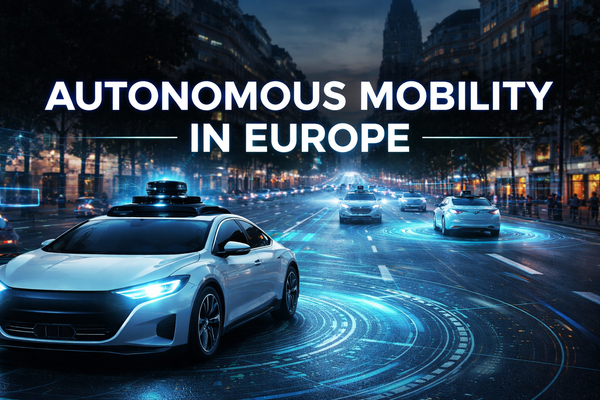
Most discussions about robotaxis focus on the US or China. But Europe follows a different path. The difference In the US: faster deployment higher risk tolerance In Europe: regulation first approach strong safety validation controlled rollout What this means Scaling will be slower. But potentially more stable. Operators must prove:
Autonomous driving in Europe is moving forward, but not in the way many expect. Tesla has submitted its Full Self Driving system for approval under European regulatory frameworks. The Dutch authority RDW is currently reviewing the application. A potential approval in the Netherlands could trigger a broader rollout across the
News
Clear, data-driven insights on robotaxi rollout, regulation and real-world operations in Europe.